Our story
I.
The beginnings
« Each one of God’s calls is an initiative of his love. He is the one who always takes the initiative. He calls you. God calls to life, he calls to faith, and he calls to a particular state in life: “I want you here”. God’s first call is to life, through which he makes us persons; it is an individual call because God does not make things in series. Then God calls us to faith and to become part of his family as children of God. Lastly, God calls us to a particular state in life: to give of ourselves on the path of matrimony, or that of the priesthood or consecrated life. They are different ways of realizing God’s design, the one he has for each of us that is always a design of love. God always calls. And the greatest joy for every believer is to respond to this call, offering one’s entire being to the service of God and our brothers and sisters »
Angélus of the 17 january 2021.
II.
The Calling of the Center
To promote, support, and disseminate research.
Its purpose is to promote and support all social science research on vocations within society—understood in the broadest sense—and all its components, whether secular or religious institutions.
With this in mind, it works to raise awareness and provide information about the dignity and complementarity of every vocation within civil society and in its service. According to the teaching of the Church, the faithful of Christ are indeed equal in dignity, while having different and complementary vocations:
:
From their rebirth in Christ, there exists among all the Christian faithful a true equality regarding dignity and action by which they all cooperate in the building up of the Body of Christ according to each one’s own condition and function. (Cann. 208, Code of Canon Law)
Located in France, the Research Center will conduct international academic research, organize events designed both to advance this research and to disseminate its findings, provide training, and oversee publications. It will thus bring together researchers—men and women, religious and lay—from every continent.
The anthropological dimension of this work could, in the future, lead to a better understanding of lay vocations, which are not “half-vocations” or second-class vocations, but are part of the universal call to holiness, grounded in Baptism—which introduces us into the Trinitarian Communion—and which was forcefully reaffirmed by the Second Vatican Council :
Fortified by so many and such powerful means of salvation, all the faithful, whatever their condition or state, are called by the Lord, each in his own way, to that perfect holiness whereby the Father Himself is perfect.
Dogmatic Constitution on the Church Lumen Gentium (21 November 1964), 11.
Pope Francis noted on the concil :
“Each in his or her own way” the Council says. We should not grow discouraged before examples of holiness that appear unattainable. There are some testimonies that may prove helpful and inspiring, but that we are not meant to copy, for that could even lead us astray from the one specific path that the Lord has in mind for us. The important thing is that each believer discern his or her own path, that they bring out the very best of themselves, the most personal gifts that God has placed in their hearts (cf. 1 Cor 12:7), rather than hopelessly trying to imitate something not meant for them. We are all called to be witnesses, but there are many actual ways of bearing witness
—Francis, Apostolic Exhortation Gaudete et Exsultate (19 March 2018), 11.
At the same time, it is a matter of understanding the specific role of the priesthood and consecrated life, which, together with lay vocations, constitute the three ways in which the faithful of Christ fulfill the call to holiness inscribed in baptism.
The research center will begin its work on the theological foundations of the priesthood in continuity with the Second Vatican Council and firmly rooted in the Great Tradition of the Church Fathers.
Our logo
Très symbols, one calling.
The tree Fish
The fish has been the symbol of Christians since the early centuries. It represents both the Father, the Son, and the Holy Spirit, as well as the three states of life: the laity, the ministerial priesthood, and the consecrated life.
The triquetra
The Trinity Knot: the unity and communion of the three divine Persons in a single substance.
The circle
Since ancient times, the circle has been a symbol of eternity: God has existed from all eternity. It also reminds us of the promise of eternal life to which we are all called.
The founder
Cardinal Marc Ouellet
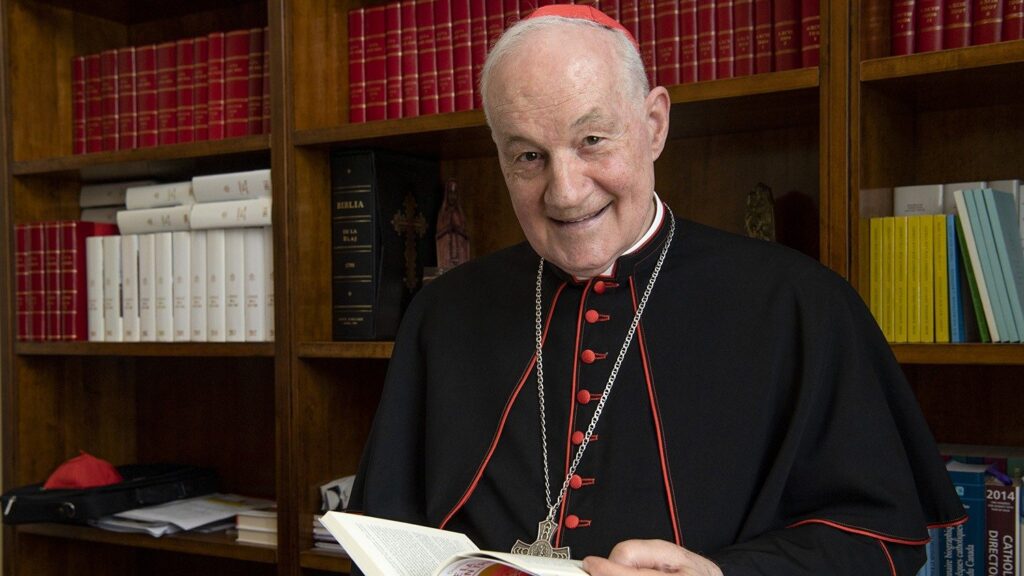
Born in Quebec in 1944, the Center’s founder entered the Major Seminary of Montreal in 1964 and was ordained a priest in the Diocese of Amos in 1968. He joined the Society of the Priests of Saint-Sulpice in 1972, after two years as a missionary in Colombia.
After earning a licentiate in philosophy (Rome, 1974), he served as rector of several major seminaries and, in 1983, earned a doctorate in dogmatic theology with a dissertation on Existence as Mission.
He held the chair of dogmatic theology at the Pontifical John Paul II Institute (Lateran, 1996–2002), was consecrated a bishop in 2001, created Cardinal-Primate in 2003, and served as Prefect of the Congregation for Bishops from 2010 to 2023.
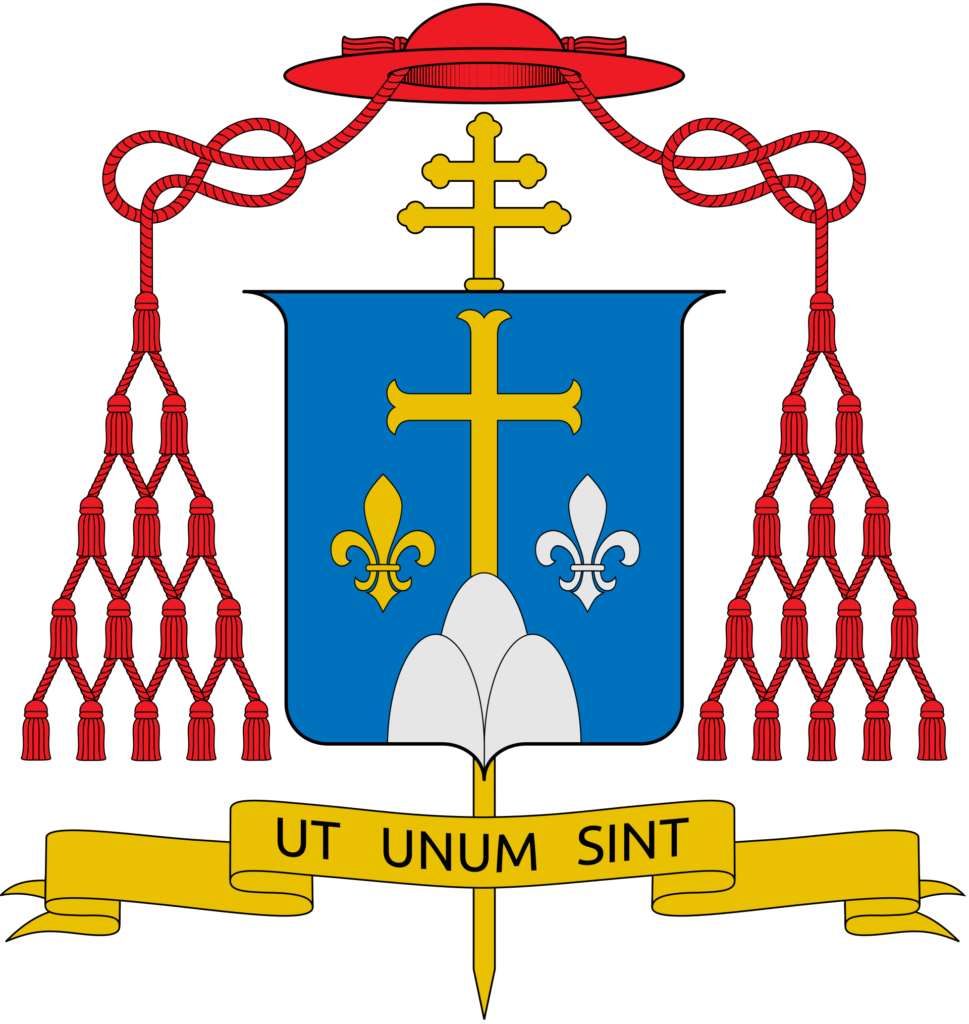
Coat of Arms: Azure, an anchored cross Or on a mountain of three silver peaks, flanked by a fleur-de-lis Or on the dexter side and a fleur-de-lis silver on the sinister side.
The azure evokes the sky of Abitibi, the birthplace of Cardinal Marc Ouellet; the fleurs-de-lis, his Quebec origins; and the cross on the mountain, the gesture of the founders of Ville-Marie at the dawn of the colony that became Montreal. The design also symbolizes the spiritual heritage received from the Society of Saint Sulpice and the Saint John Community, founded by Hans Urs von Balthasar and Adrienne von Speyr: the glorious cross on Calvary signifies the victory of Trinitarian Love over sin and death; the golden lily represents Mary, symbol of the Immaculate Church; the silver lily represents John, symbol of reconciled humanity. The whole design bears witness to the unity of the Church for which the Lord prayed. The motto Ut unum sint, “May they be one,” is taken from Jesus’ high priestly prayer (Gospel according to Saint John, 17:21). It also refers to John Paul II’s encyclical Ut unum sint on ecumenical commitment (May 25, 1995) and to Cardinal Ouellet’s first episcopal ministry as Secretary of the Pontifical Council for Promoting Christian Unity (2001–2002).
Coat of arms: Azure, an anchored cross Or on a mountain of three silver peaks, flanked by a fleur-de-lis Or on the dexter side and a fleur-de-lis silver on the sinister side.
The azure blue evokes the sky of Abitibi, the birthplace of Cardinal Marc Ouellet; the fleurs-de-lis, his Quebecois origins; and the cross on the mountain, symbolising the actions of the founders of Ville-Marie at the dawn of the colony that became Montreal. The design as a whole also symbolises the spiritual heritage received from the Society of Saint Sulpice and the Saint John Community, founded by Hans Urs von Balthasar and Adrienne von Speyr: the glorious cross on Calvary signifies the victory of Trinitarian Love over sin and death; the golden fleur-de-lis represents Mary, symbol of the Immaculate Church; the silver lily represents John, symbol of reconciled humanity. The whole bears witness to the unity of the Church for which the Lord prayed. The motto Ut unum sint, ‘May they be one’, is taken from Jesus’ high priestly prayer (Gospel according to Saint John, 17:21). It also refers to John Paul II’s encyclical *Ut unum sint* on ecumenical commitment (25 May 1995) and to Cardinal Ouellet’s first episcopal ministry as Secretary of the Pontifical Council for Promoting Christian Unity (2001–2002).